
Slug: water-recovery-in-industry
Focus Key Phrase: industrial water recovery
Meta Description:
Learn why industrial water recovery is more impactful than household water-saving. Discover how reusing water in agriculture and industry can reshape sustainability.
Think Bigger Than the Tap
Turning off the tap while brushing your teeth is a good habit — but if we want to tackle the global water crisis seriously, we need to look beyond the bathroom. The real opportunity lies in transforming how industries and agriculture use water.
Direct Use vs. Productive Use
The amount of water a person uses daily at home — for drinking, cooking, or cleaning — is minimal compared to the water required to produce the goods we consume.
- Millions of cubic meters of water are used annually in agriculture and manufacturing
- Each liter recovered in a factory or on a farm can save hundreds of liters in water footprint across the supply chain
What Is Water Recovery?
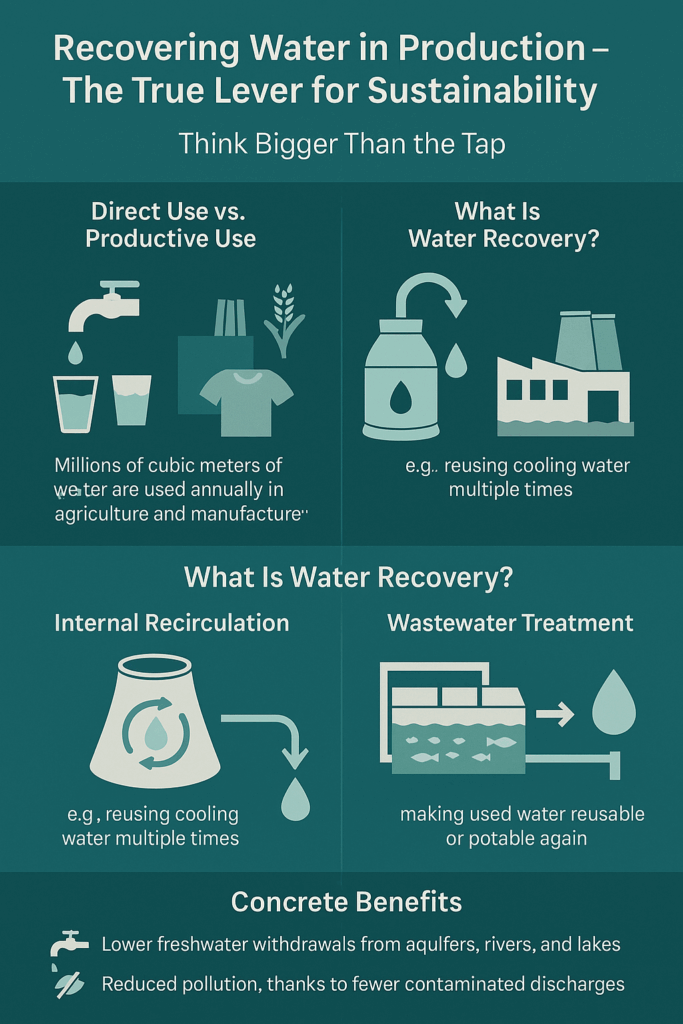
Water recovery refers to techniques that reuse water within production cycles, reducing the need to extract fresh water. The two primary strategies are:
- Internal recirculation – e.g., reusing cooling water multiple times
- Wastewater treatment – making used water reusable or even potable again
Concrete Benefits
- Lower freshwater withdrawals from aquifers, rivers, and lakes
- Reduced pollution, thanks to fewer contaminated discharges
- Higher water productivity: more output with less water
In Europe, over 50% of available water is used by industry (in Belgium, it’s around 80%). Improving water efficiency in these sectors offers massive environmental and economic returns.
Case in Point: Irrigation
Traditional agriculture loses up to 50% of irrigation water to evaporation or leakage. Modern technologies like drip irrigation drastically reduce waste and boost crop yields — proving that smart water use pays off in both sustainability and performance.
Coming Up…
In the next chapter, we’ll look at how industry is shifting from linear to circular water management, using innovative technologies. We’ll showcase real-world examples and measurable results that demonstrate what’s possible.