
Water recovery is not just ethical — It’s smart business
Investing in water recovery and reuse isn’t just the right thing to do. It’s a strategic decision that delivers tangible advantages at every level: environmental, economic, operational, and reputational.
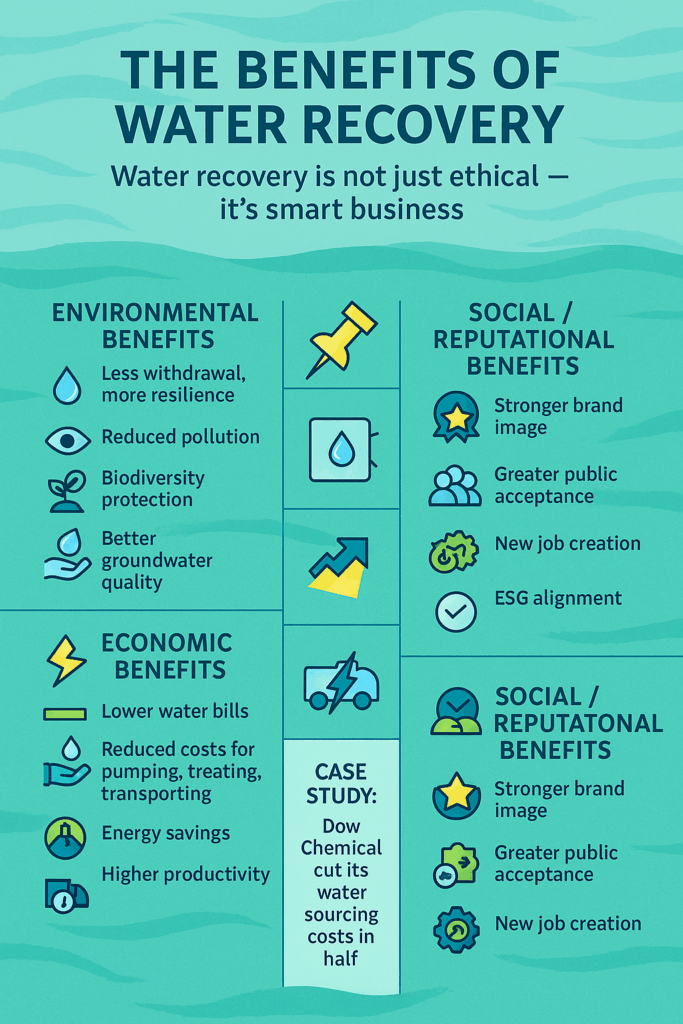
Environmental Benefits
- Less withdrawal, more resilience: every cubic meter saved remains available for rivers, aquifers, and communities.
- Reduced pollution: by reusing water, you avoid discharging harmful substances like detergents, metals, and dyes.
- Biodiversity protection: less water stress means healthier ecosystems and fewer “dead zones.”
- Better groundwater quality: precision irrigation limits fertilizer runoff, protecting aquifers.
Economic Benefits
- Lower water bills
- Reduced costs for pumping, treating, and transporting water
- Energy savings: less water movement means less energy used
- Higher productivity: stable process temperatures and fewer shutdowns
Case Study: Dow Chemical cut its water sourcing costs in half by using treated municipal wastewater.
Social and Reputational Benefits
- Stronger brand image: sustainable companies attract investors, customers, and top talent
- Greater public acceptance, especially in regions where industry and residents share water resources
- New job creation in green tech, water monitoring, and system maintenance
- ESG alignment, critical for global companies and impact-driven investors
The real water we use is often invisible
Saving water at home matters — but it’s not enough. Most of the water we “consume” is invisible, hidden in the products we use every day. This is virtual water — and managing it is the real path to sustainability.
Look Beyond Direct Use
Focusing only on domestic water use means missing the bigger picture. Today we know:
- Over 89% of our water footprint comes from food
- Most water is used for production, not consumption
- Every product has a hidden water story — often long and impactful
Innovation starts in the production chain
Agriculture and industry are the true levers of change. Acting here means:
- Optimizing resources and costs
- Reducing global environmental impact
- Creating circular value from water
The right technologies already exist. The real challenge is scaling them up.
The true value of hidden water
The concept of virtual water forces us to rethink how we treat natural resources. We can no longer afford a superficial or inefficient approach.
Taking action on hidden water means:
- Making supply chains more transparent and sustainable
- Improving industrial competitiveness
- Ensuring long-term water availability for future generations
The water you don’t see is the one that matters most.
Investing in technology to recover it is the smartest move we can make today.
Coming Up…
In the final chapter, we’ll explore our proprietary TVI technology and how it fits into the future of water virtualization.