
A shift in industrial water use
Modern industries consume vast amounts of water — for cooling, cleaning, transporting materials, and processing products. But today, many companies are changing course: moving from passive water users to smart, circular systems that reuse water and minimize waste.
How Water Is Used in Factories
In industrial settings, water is used in many ways:
- As a raw material (e.g., food and beverage industry)
- As a process medium (rinsing, material transport)
- For cooling and heat exchange
- For industrial cleaning and sanitation
Traditionally, used water was simply discharged. Now, thanks to advanced technologies, the goal is to close the water loop.
Water recovery technologies — Real-World cases
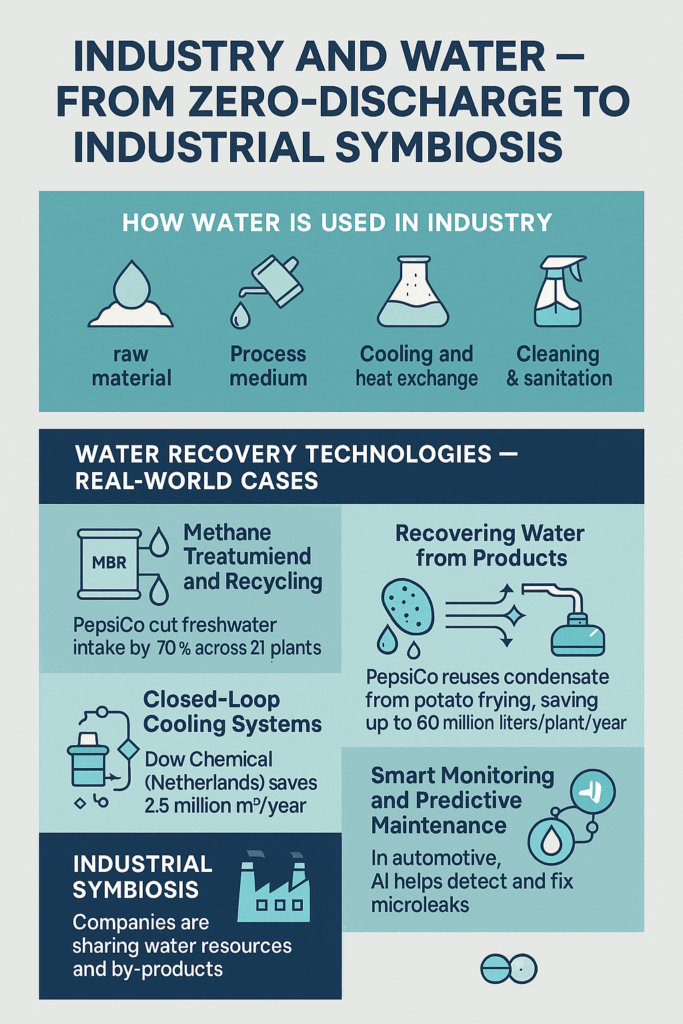
1. Process Water Treatment and Recycling
Internal systems using membrane bioreactors (MBR) and advanced filtration can make process water reusable — even for food applications.
Example: PepsiCo cut freshwater intake by 70% across 21 plants using treated process water.
2. Recovering Water from Products
Some industries now extract water from raw materials during processing and reuse it internally.
Example: In PepsiCo’s snack plants, water released from frying potatoes is condensed and reused — saving up to 60 million liters per plant per year.
3. Closed-Loop Cooling Systems
Evaporative towers and condensers allow cooling water to be recirculated with minimal loss.
Example: Dow Chemical in the Netherlands uses treated municipal wastewater in its industrial cycles, saving 2.5 million m³ of freshwater annually.
4. Smart Monitoring and Predictive Maintenance
Sensors and AI algorithms detect hidden leaks, optimize processes, and improve quality control.
Example: In the automotive sector, smart water monitoring has identified and resolved micro-leaks, saving tens of thousands of cubic meters per year.
Industrial symbiosis
More and more companies are sharing water resources and by-products:
- Wastewater from one process can become a resource for another
Example: Nutrient-rich wastewater used for agricultural fertigation
Coming Up…
In the next chapter, we’ll explore the tangible benefits of smart water management — environmental, economic, and reputational. You’ll see why water recovery isn’t just good for the planet — it’s great for business.