Sewage sludge is one of the most complex byproducts of urban management: rich in nutrients, yet burdened by logistical, health, and environmental challenges. However, with the right technologies, it can be transformed from a costly waste into a valuable agricultural resource, reducing disposal costs, environmental impact, and dependence on landfills.
TVI, developed by Pherkard Tech, offers a compact, safe, and replicable solution suitable for public authorities, plant operators, and environmental districts.
Safe, Low-Impact Thermal Treatment
The Pherkard process operates:
- In a closed, vacuum environment, avoiding odour emissions,
- at moderate temperatures, sufficient for hygienization,
- With continuous movement, which improves dehydration without burning the material.
Compared to conventional dryers:
- It avoids the use of contaminated airflow,
- It reduces the risk of microbiological aerosol release,
- It neutralises pathogens without chemicals or excessive heat.
The result is sanitised, stabilised sludge with <10% moisture content—ready for safe storage, transport, and reuse.
Volume Reduction and Cost Savings
Urban sludge typically contains over 75% water. Drying it offers key benefits:
- up to 80% volume reduction,
- lower transport and disposal costs,
- simplified storage, even for small or decentralised facilities.
Example: 10 tons of sludge at 75% moisture becomes about 2 tons of dry residue, easily transported in a single trip.
This allows greater flexibility in reuse, whether for agriculture, energy recovery, or industrial processes.
Producing Agronomic-Grade Biosolids
Properly treated and analysed dry sludge can become a natural fertiliser or soil conditioner. Common uses include:
- direct application as stabilised biosolid,
- blending with compost or manure to improve soil structure,
- recovery of nutrients such as phosphorus, potassium, and organic carbon.
Pherkard Tech’s controlled temperature process ensures:
- preservation of nutrients and trace elements,
- production of a dry, flowable powder or granule, suitable for dosing or pelletizing,
- compliance with regulations for reuse (e.g., as fertiliser or byproduct).
From Burden to Circular Resource
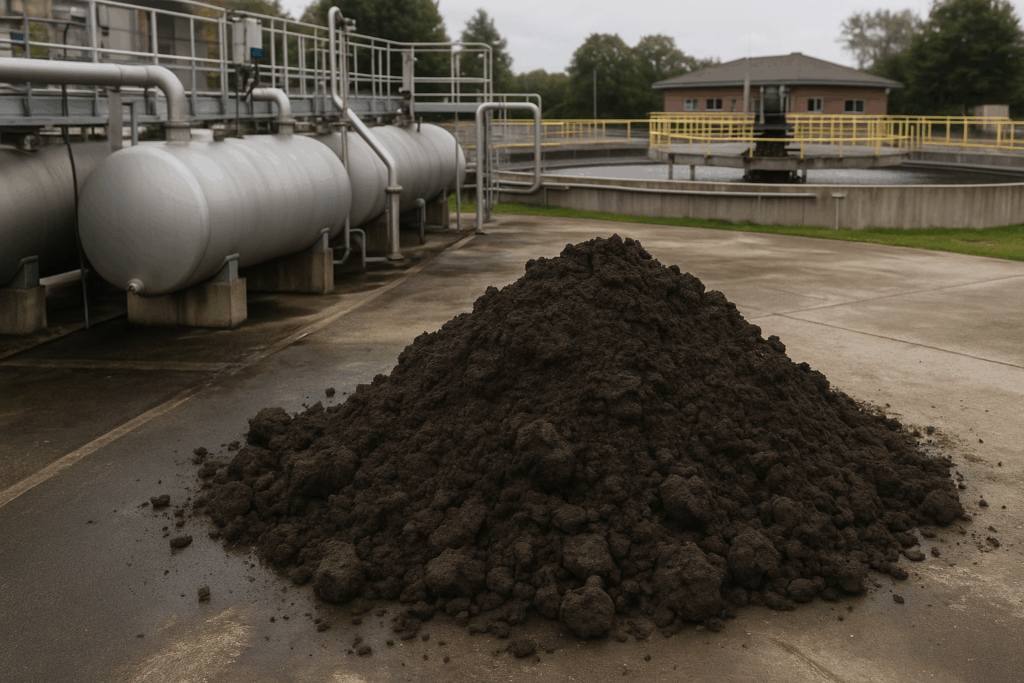
With advanced drying, urban sludge is no longer a liability. It becomes a resource that can be:
- efficiently processed (up to 90% volume reduction),
- safely sanitised (no pathogens, no chemical residues),
- usefully repurposed (for agriculture, composting, or bioenergy).
Pherkard Tech offers scalable, modular solutions—even for space-constrained settings such as municipal plants, agro-industrial hubs, or small utilities.
A replicable, sustainable model that turns urban residues into real value.