
Beyond the Tap: What We Really Consume
The water we use at home — to drink, cook, clean — is only a small part of our actual water footprint. Much of our impact is hidden in the things we consume daily: food, clothes, devices.
To understand and manage this invisible water use, we need a key concept: the water footprint.
What Is a Water Footprint?
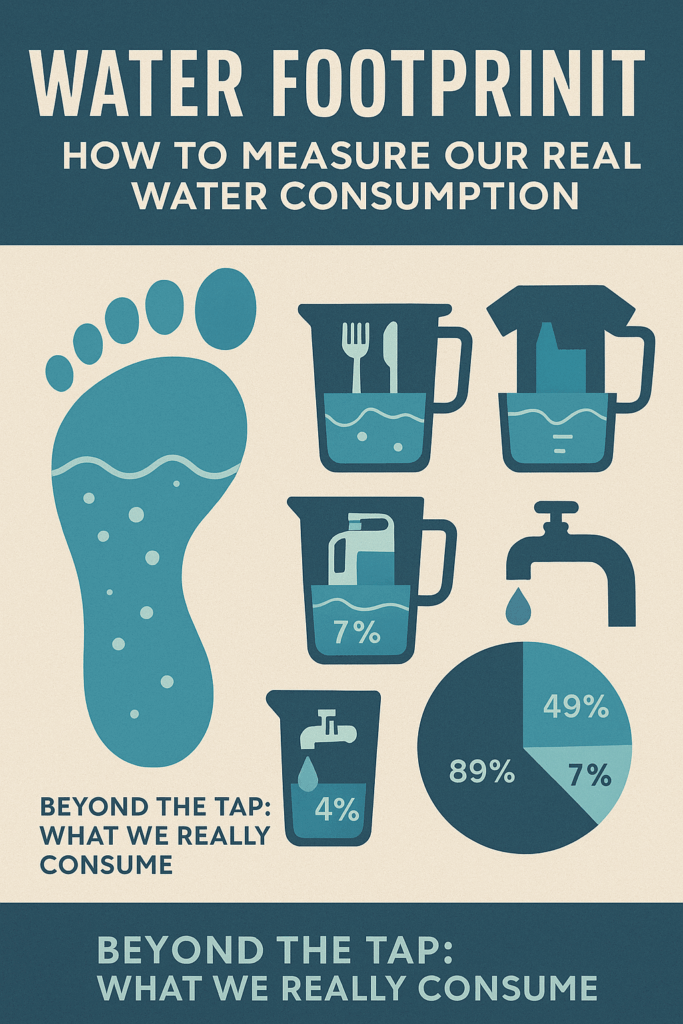
The water footprint measures the total volume of freshwater used to produce goods and services. It includes:
- Direct use: water for drinking, washing, and cooking
- Indirect use: water embedded in the products we consume
It can be calculated for:
- an individual (daily consumption)
- a product (e.g., 1 kg of meat, a pair of jeans)
- a business or entire country
Surprising Water Footprint Statistics
- 70% of all freshwater is used for agriculture
- 20% goes to industry
- Just 10% is for household use
In some cases, when rainwater absorbed by crops is also considered, agriculture’s share can reach up to 90% of all water consumption.
The Case of Italy
In Italy, the average daily water footprint per person exceeds 6,000 liters, broken down as follows:
- 89% linked to food (farming and livestock)
- 7% from industrial goods
- Only 4% from direct domestic use
And here’s the kicker: Italy is one of the top global importers of virtual water — over 62 billion cubic meters each year — through imported goods and raw materials.
Why Monitoring Water Footprint Matters
Understanding your water footprint allows:
- Businesses to optimize production efficiency
- Governments to design better water policies
- Consumers to make more informed and sustainable choices
Your water footprint is a mirror of sustainability: the higher it is, the greater your hidden environmental impact.
Coming Up…
In the next chapter, we’ll explore why recovering water in production processes is far more impactful than cutting water use at home. We’ll show how tackling hidden water use is the smartest move toward a more resilient and sustainable future.